
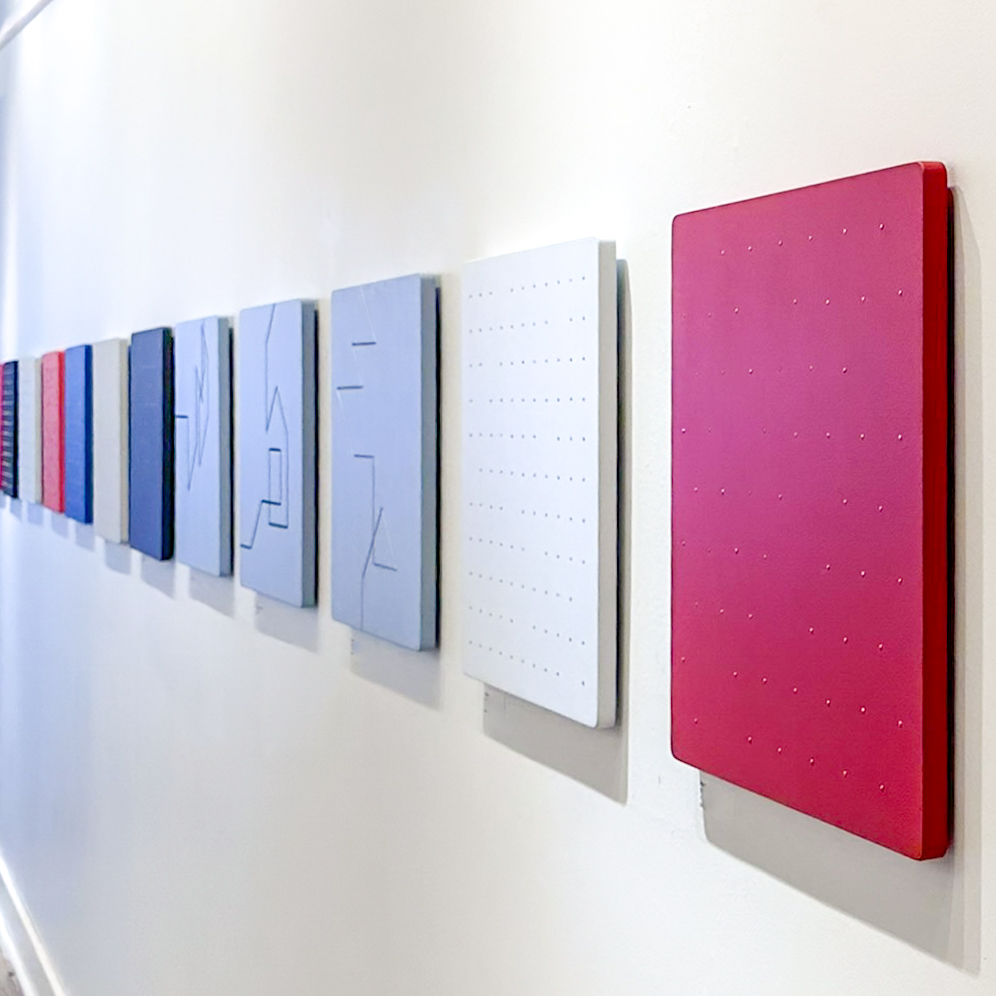

Rupen’s Full Measure is a show that reveals its complexity gradually. Take your time. Fourteen panels, approximately sixteen inches square are evenly spaced across the long wall of the gallery. Each panel is anchored by a single colour. So far, so simple. But on closer inspection the surfaces reveal structure, lines, and grids. As these details draw you in, you’ll notice further complexity. Variations and omissions disturb the apparent order. Within these meticulously crafted pieces are traces of deeper systems, rules inflected by chance.

Consider, for example, the piece titled RWB/11GL/W: a pale grey square marked with a grid of small dark points. Up close, the points reveal themselves to be tiny nails projecting from the surface. You’ll notice that there appear to be some gaps in the grid: some points are missing. At first these absences appear random, but you’ll discover there’s an order to them. There is precisely one, and only one, missing point in each row and one in every column. This pattern is generated through a combination of rules and chance. Rupen uses dice to select the missing point in the first row, starting with any column. He then progresses down, row by row. Once a column has been selected, it cannot be used again. The choices therefore become increasingly constrained as he moves down the grid. By the final row, only one column choice remains. Rupen establishes the rules that determine the structure, but chance determines the particular arrangement.

Architectural paint on primed MDF with nails, 15 7/8” x 15 7/8” , 2022

Architectural paint on primed MDF with nails, 15 7/8” x 15 7/8” , 2022
Then there is B/DH/S/WB/DG, a dark grey panel with a similar grid of dots. The discovery that some of the dots are perfectly flush nail-heads is surprising enough; more surprising still is realizing that some of the black dots are not marks, but holes drilled into the surface. Once again, some of the nodes are missing, and amongst the points that remain, a different set of rules determine their physical expression. The apparent simplicity of the pattern conceals a surprisingly complex set of decisions.

Considering the precision and level of finish in these pieces, it will come as no surprise that Rupen has a past professional background as a carpenter and cabinetmaker. Rupen has turned the skills of his trade into the medium of his art, his current full-time occupation. The work depends on precision, measurement and perfect alignment. Look at the tiny nail-heads, perfectly flush with the surfaces, or the precisely positioned holes. It’s the level of craftsmanship found in fine furniture. I asked him about the Shelter series, where paint-filled grooves inscribe the surface. Surely some kind of robot was involved in these incisions? But no. They are made with nothing more sophisticated than a straightedge and a router. The remarkable degree of technical control makes Rupen’s use of rules and randomness even more compelling.

His technical skill gives Rupen extraordinary control over how his pieces are made, and yet he deliberately gives up some control over what they become. The variability he introduces operates only within very narrow constraints, but it is nevertheless an important part of the creative process. Randomness, in this context, is not the opposite of control. It’s more like a creative partner, introducing possibilities that Rupen would not entirely anticipate. He designs and controls the system and the technical execution, but he does not control the outcome.


In Rupen’s work, complexity is revealed from within a framework of restraint. The compositions are spare, and the execution seamlessly precise. As you look closer and pay attention, other systems and patterns emerge. Beneath its apparent simplicity is a delicate negotiation between control and unpredictability, precision and chance. The result is work that continues to unfold the longer you look.
Leave a Reply